How to choose
Tent, sleeping bag and pack: what to buy in which order
Buy the sleep system first, the shelter second and the pack last. The order decides whether a $750 kit costs $7.50 a night or $25.00.
Most first camping kits are bought backwards. The pack goes in the basket first because it is the item that looks like camping, then a tent chosen on floor area, and whatever sleeping bag is left in the budget. The result is a bag that does not reach the temperatures you actually camp in and a pack that is the wrong volume for the kit it has to carry.
The order below reverses that, for one reason: the only part of the kit that decides whether the trip is survivable rather than merely uncomfortable is what you sleep in. Every price in this guide is an example used to show the arithmetic; no prices are quoted and nothing here has been tested.
Buy the sleep system first, because it decides the trip
A sleeping bag and a pad are one purchase, not two. The pad does roughly half the work of keeping you warm, because the insulation under you is compressed flat by your own weight and a bag alone cannot replace it. Buying a good bag and a thin foam pad is the most common way to be cold in a warm-rated bag.
Ratings are the second trap. Where a bag carries two figures, a comfort rating and a lower limit, the comfort figure is the one to plan around and the limit is usually the one printed largest. A bag advertised with a single number tells you nothing about which of the two it is, and the fix is to read the specification page rather than the hang tag.
Plan for the coldest night you would actually go out in, not the average one. The National Weather Service's cold safety guidance notes that hypothermia occurs when the body loses heat faster than it can produce it, and that people exposed to extreme cold can succumb in a matter of minutes. A bag chosen for the average night is a bag chosen for the night you were not worried about.
- Decide the coldest night you would actually sleep out in, not the typical one
- Choose the pad first and the bag to match it, because the pad is half the insulation
- Read the comfort figure on the specification page rather than the number on the tag
- Check the packed size and weight before the colour, the zip side or the hood shape
- Buy a liner before you buy a warmer bag, because it is a fraction of the price
The three numbers on a tent that matter
Minimum weight and packed weight are different numbers and manufacturers publish both. Minimum weight is the fly, the inner and the poles. Packed weight adds the stakes, guy lines, stuff sacks and anything else in the box. The difference is often several hundred grams, and the pack you buy next has to carry the packed weight.
Floor area tells you less than floor shape. A two-person tent with a tapered foot is a two-person tent for two people who are friends; the same area in a rectangle sleeps two strangers. Read the floor plan dimensions rather than the square footage, and read the peak height against where the peak actually is.
Freestanding or not is the question that depends on where you camp rather than on preference. A tent that needs stakes cannot be pitched on slickrock, on a wooden platform or on frozen ground, and that one limitation rules out a lot of otherwise excellent shelters for a lot of otherwise excellent trips.
| Specification | What it tells you | What it does not |
|---|---|---|
| Minimum weight | Fly, inner and poles only | What you will actually carry |
| Packed weight | Everything in the box, including stakes and sacks | What it weighs once you leave the sacks at home |
| Floor dimensions | Whether two pads fit side by side | How much of that area is full height |
| Peak height and position | Whether you can sit up, and where | Anything about headroom at the foot |
| Freestanding or staked | Whether you can pitch on rock or a platform | How it behaves in wind once guyed |
Minimum and packed weight both appear on most manufacturers' specification pages. Use packed weight when sizing the pack in the next section.
The pack comes last, because it is sized to the rest
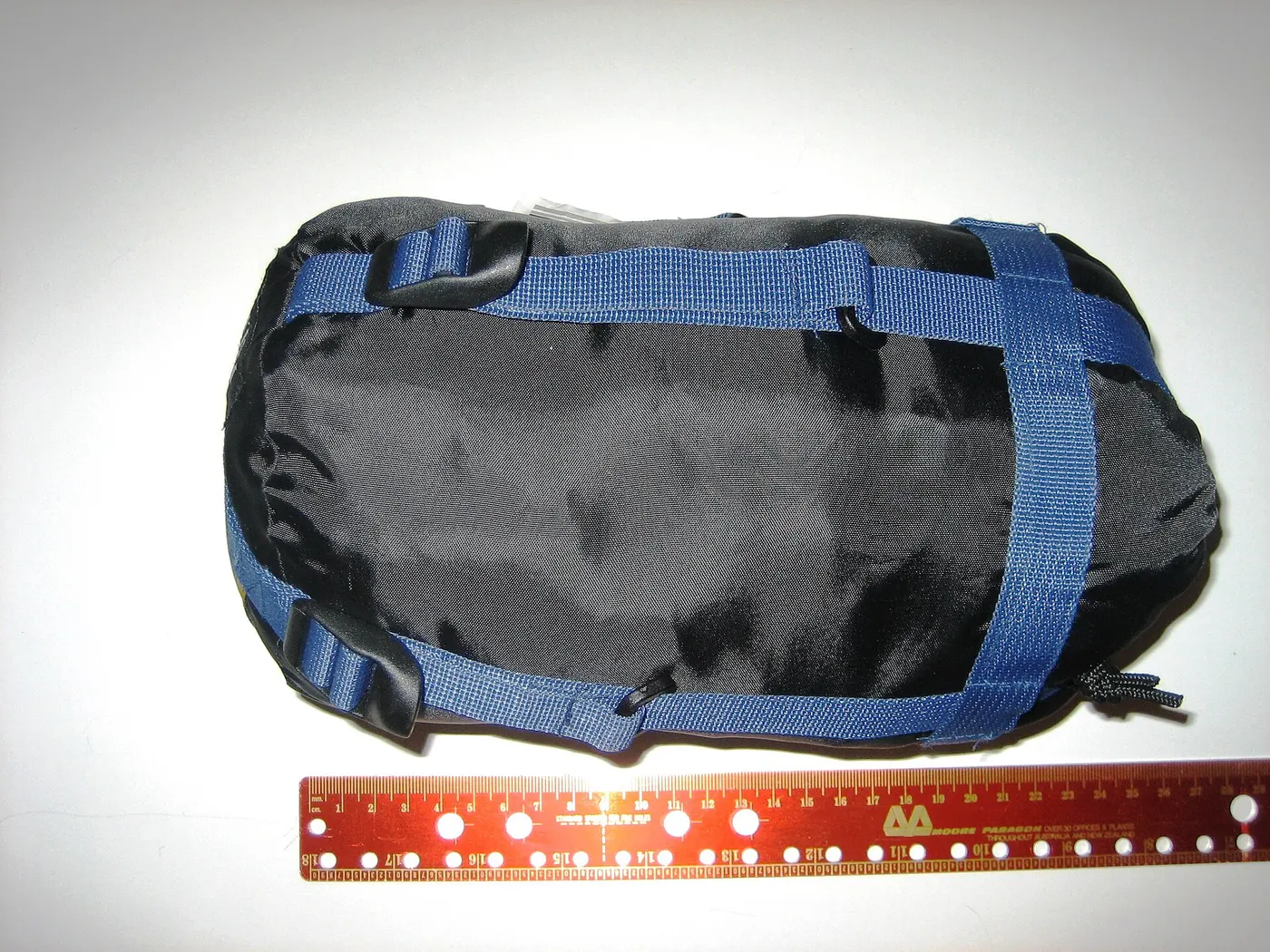
A pack is a container, and you cannot size a container before you know what goes in it. Pack the bag, the pad and the tent into a cardboard box and measure what they occupy, and you have the volume figure that the shop cannot give you.
Torso length, not height, decides fit. Two people the same height can need different pack sizes because the distance from the seventh vertebra to the top of the hip bones differs, and a pack that is the wrong length puts the load on the shoulders regardless of how the hip belt is tightened.
Buy the volume you need for the trips you take, not for the trip you imagine. An oversized pack is heavier empty and fills itself, which is the quiet mechanism behind most of the weight problems the packing guide on this site works through.
- Measure torso length rather than relying on height when choosing a frame size
- Pack the sleep system and shelter into a box first and measure the volume they take
- Load the pack to full weight in the shop before deciding the belt fits
- Compare empty weights: a pack can be a tenth of everything you carry
What the order costs per night
Take an example kit: a $250 sleep system, a $300 tent and a $200 pack, which is $750. Used 20 nights a year and kept 5 years, that is 100 nights and $7.50 a night. Used 6 nights a year over the same 5 years it is 30 nights and $25.00 a night.
Used 40 nights a year over 5 years it is 200 nights and $3.75 a night, and the same figure comes out of 20 nights a year across 10 years. Nights used and years kept multiply, which is why durability and frequency matter equally and price matters less than either.
This is the number that makes the buying order worth caring about. A $300 tent that lasts a decade is cheap. A $150 tent replaced twice because the floor wetted through is not, and the difference only shows up in this division.
| Nights per year | Over 3 years | Over 5 years | Over 10 years |
|---|---|---|---|
| 6 nights | $41.67 | $25.00 | $12.50 |
| 20 nights | $12.50 | $7.50 | $3.75 |
| 40 nights | $6.25 | $3.75 | $1.88 |
Each cell is $750 divided by nights per year multiplied by years. The $7.50 figure is the one carried into the trip-cost guide on this site.
The things to carry regardless of what you bought
The National Park Service publishes a ten-item list as the minimum for anyone recreating outdoors: navigation, sun protection, extra clothing, illumination, first-aid supplies, fire, a repair kit and tools, nutrition, hydration and emergency shelter. It describes these as the minimum items everyone should have at all times outdoors.
Two of those ten are explicitly about the failure of the kit you just chose. Emergency shelter is there in case the tent is not usable, and extra clothing is there in case the bag is not enough. Buying the tent does not remove the line.
The nutrition item carries the one quantity the Park Service puts a number on: pack an extra day's supply of food. For a two-night trip that is three days of food, which is the figure the base weight guide on this site uses.
Before you buy
- Write down the coldest overnight temperature you would actually camp in
- Choose the pad and bag together and check the comfort figure, not only the limit
- Read both minimum weight and packed weight from the tent's specification page
- Check the floor plan dimensions rather than the square footage
- Decide whether you need a tent that pitches without stakes
- Measure your torso length before choosing a pack size
- Pack the sleep system and tent into a box and measure the volume before buying the pack
- Divide the kit total by nights per year times years kept before deciding it is expensive
Questions readers ask
- Can I use a cheap foam pad with a good sleeping bag?
- You can, and in summer it is often enough. In cold conditions it is the usual reason a warm-rated bag feels cold, because the insulation beneath you is crushed flat by your own weight and the pad is doing that job instead. Treat pad and bag as one purchase with one combined rating in mind.
- How do I know what temperature rating I need?
- Work from the coldest night you would still go out in, not the average. Then plan around the comfort figure rather than the lower limit, since the limit describes a curled, just-not-cold condition rather than a night's sleep. A liner is the cheap way to extend a bag you already own.
- Is a freestanding tent always better?
- It is more flexible about where it can be pitched, which matters on rock, platforms and frozen ground where stakes will not hold. It is usually heavier for the same floor area, because the poles do work the ground would otherwise do. Where you camp decides it rather than which is better in the abstract.
- What pack volume should I buy for weekend trips?
- Measure rather than guess: put the bag, pad and packed tent into a box and see what they occupy, then add food and clothing. Buying by litres on a shelf tends to produce a larger pack than needed, and a larger pack fills itself with things you would not otherwise have carried.
- Is it cheaper to rent for the first few trips?
- On the cost-per-night table it usually is below about 6 nights a year, where an example $750 kit works out at $25.00 a night over 5 years. Above roughly 20 nights a year the same kit is $7.50 a night, and renting stops competing. The crossover is set by how often you go, not by the price of the gear.
Sources
- National Park Service - The Ten Essentials (navigation, sun protection, extra clothing, illumination, first-aid, fire, repair kit and tools, nutrition including an extra day's food, hydration, emergency shelter) — checked 2026-11-03
- National Weather Service - Cold Weather Safety (hypothermia occurs when the body loses heat faster than it can produce it; extreme cold can cause hypothermia in minutes) — checked 2026-11-03
Some links on this site can earn us a commission. That does not change which product a guide recommends, and it adds nothing to your price. Advertising is not enabled on this site yet. When it is, ads will be labelled and kept visually separate from the guides.